Learn
/
A Simple Guide to MHT / HRT in Singapore

A Simple Guide to MHT / HRT in Singapore

August 11, 2026

What happens to your hormones during perimenopause?

Perimenopause is the stage of life when your body begins transitioning towards menopause. It can last several years before your final menstrual period.

During this time, your ovaries gradually produce less oestrogen. However, the change is not always gradual. Oestrogen levels can fluctuate significantly, which is why symptoms can appear, disappear and change over time [1, 2].

Oestrogen affects many parts of the body, not just your reproductive system. Oestrogen receptors are found in the brain, bones, blood vessels, skin and joints, among other tissues.

As your oestrogen levels change, you may experience:

  • Hot flushes and night sweats
  • Difficulty sleeping
  • Brain fog and difficulty concentrating
  • Mood changes, irritability or anxiety
  • Joint and muscle aches
  • Changes in your periods
  • Vaginal dryness or discomfort during sex
  • Urinary symptoms

Not every woman experiences the same symptoms, and symptoms can change throughout perimenopause [1, 2].


What is MHT?

Menopause Hormone Therapy (MHT) replaces some of the oestrogen your body is no longer producing consistently.

You may also hear it called Hormone Replacement Therapy (HRT). The terms MHT and HRT generally refer to the same type of treatment.

The main hormone used in MHT is oestrogen.

If you still have a uterus, you will usually also need progesterone or another type of progestogen alongside systemic oestrogen. This protects the lining of the uterus from becoming too thick.

MHT can help with:

  • Hot flushes and night sweats: MHT is the most effective treatment for these symptoms and can reduce their frequency and severity by around 75% [3].
  • Sleep problems: Reducing night sweats and other menopause symptoms can help improve sleep [4].
  • Brain fog and mood changes: Some women experience improvements in cognitive symptoms, irritability and mood changes [2, 4].
  • Joint and muscle aches: These are common during perimenopause and are among the frequently reported menopause symptoms in Singaporean women [5, 6].
  • Bone health: Oestrogen helps maintain bone density, and MHT can help reduce the bone loss that occurs around menopause [7, 8, 14].


Why is MHT controversial?

You may have heard that HRT is dangerous or increases the risk of breast cancer, heart disease and blood clots.

Much of this concern comes from a large study called the Women’s Health Initiative (WHI), whose initial results were published in 2002.

The results received enormous media attention, and many women stopped taking HRT. The concerns also influenced menopause care for many years [7, 8].

Since then, researchers have looked more closely at the results and found that the risks and benefits of MHT depend on who is taking it, when they start it, which hormones they use and how the hormones are given [7, 8, 9].


Why does this matter?

The women in the study were generally older

The average age of women in the WHI was around 63. Many were more than 10 years past menopause and already had cardiovascular risk factors [7, 8].

This is very different from a healthy woman in her 40s or 50s who is experiencing perimenopause symptoms.

Today, we know that the benefits and risks of MHT are different for a woman who starts treatment around the time of menopause compared with someone who starts it much later [7, 8].

The hormones used were also different

The WHI studied older hormone preparations, including oral conjugated equine oestrogen and medroxyprogesterone acetate [3, 7].

Today, there are more choices. These include different types of oestrogen, progesterone and progestogens, as well as different ways of taking them, such as through the skin or by mouth [3, 14].

When you start MHT matters

For healthy women without reasons not to take MHT, starting treatment before age 60 or within 10 years of menopause is generally associated with a favourable balance of benefits and risks [7, 8, 9, 10].

This is sometimes called the “window of opportunity” for MHT.

This does not mean that MHT is completely risk-free, or that every woman under 60 should take it. It means that your age and how long it has been since menopause are important when your doctor assesses whether MHT is suitable for you.


What MHT options are available in Singapore?

MHT comes in several forms. The right option depends on your symptoms, medical history, risk factors and preferences.

At Hey Taylor, we offer a range of MHT options, including oestrogen gels, patches and tablets, progesterone, combined tablets, tibolone and local vaginal oestrogen.

Oestrogen: Gel, Patches or Tablets

Oestrogen can be taken in three main ways.

Oestrogen gel

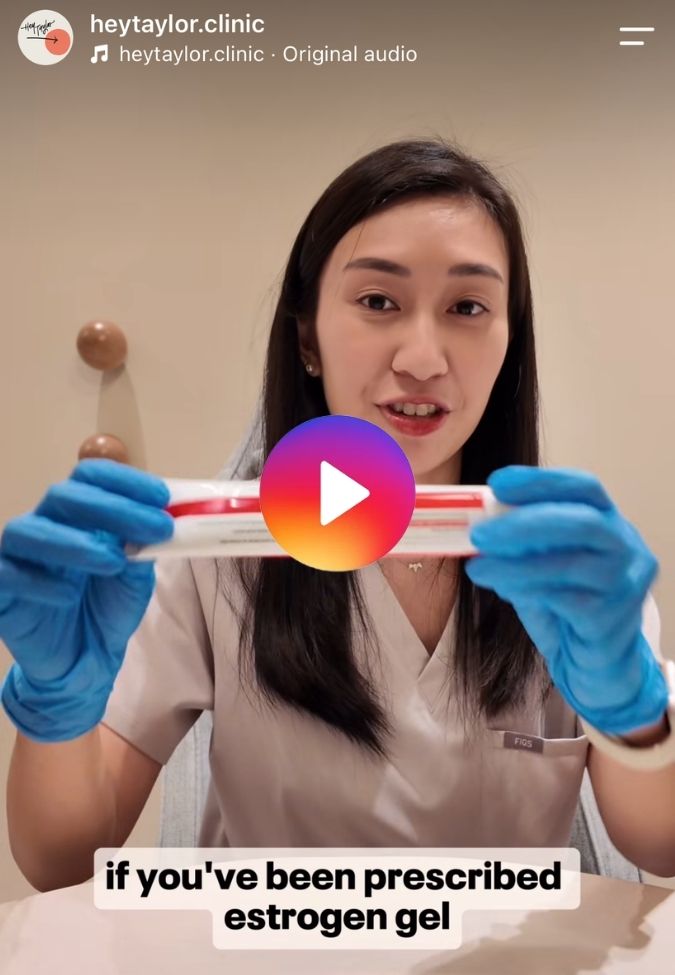
Oestradiol gel is a commonly used form of MHT in Singapore.

It is applied to the skin once a day, allowing oestradiol to enter the bloodstream without first passing through the liver.

At Hey Taylor, we commonly prescribe oestradiol gel in a tube, but patches and oral oestradiol tablets are also available options depending on your needs.

Oestrogen patches

Oestradiol patches are placed on the skin and replaced according to the product schedule, usually once or twice a week.

Like oestradiol gel, patches deliver oestrogen through the skin rather than through the digestive system.

Oral oestrogen tablets

Oestradiol can also be taken as a daily tablet.

Some women prefer tablets because they are simple and familiar. However, oral and transdermal oestrogen are not identical in how they affect the body, so your doctor will consider your individual risk factors when choosing between them [14].

Why do many doctors use oestrogen through the skin?

Oestrogen delivered through the skin has less effect on the liver’s clotting system than oral oestrogen [14].

For this reason, it is often preferred for women with certain risk factors, such as a higher BMI or migraine, depending on their individual circumstances.

What about progesterone?

If you still have a uterus and are using systemic oestrogen, you will generally need progesterone or another progestogen to protect the lining of the uterus.

One commonly used option is micronised progesterone, which has the same molecular structure as the progesterone naturally produced by the body.

It is often taken at bedtime because some women find it calming or sleep-promoting.

Other options include synthetic progestogens such as dydrogesterone and norethisterone [3, 14].

What about combined tablets?

If you prefer to take one tablet rather than separate oestrogen and progesterone, there are combined MHT tablets that contain both hormones.

These can be a convenient option for women who need both oestrogen and protection of the uterine lining [3].

Tibolone

For women who are at least 12 months past their final period, another option is tibolone, a single daily tablet.

Tibolone is broken down by the body into compounds that have oestrogen-like, progesterone-like and mild androgen-like effects.

It can help relieve menopause symptoms such as hot flushes and may also benefit bone health, mood and sexual desire.

Your doctor will consider your age, menstrual status, symptoms and medical history before recommending tibolone.


What if I only have vaginal or urinary symptoms?

You don’t necessarily need whole-body hormone treatment if your main symptoms are vaginal or urinary.

When oestrogen levels fall, the tissues around the vagina and urinary tract can become thinner, drier and more sensitive.

This can cause:

  • Vaginal dryness
  • Burning or irritation
  • Discomfort during sex
  • Urinary discomfort
  • Recurrent urinary tract infections

These symptoms are known as Genitourinary Syndrome of Menopause (GSM) [3, 4, 15].

Vaginal oestrogen creams and pessaries

Local vaginal oestrogen delivers a small amount of oestrogen directly to the vaginal tissues rather than throughout the whole body.

In Singapore, conjugated oestrogen cream is a commonly used vaginal oestrogen option.

Other options include:

  • Oestradiol vaginal tablets or pessaries
  • Oestradiol cream
  • Estriol cream
  • Conjugated oestrogen cream

At Hey Taylor, we offer oestradiol and estriol vaginal creams as well as other local vaginal oestrogen options.

Only a small amount of local vaginal oestrogen is absorbed into the bloodstream, and it can be used long term in many women [3].

It can also be used alongside systemic MHT if you have both whole-body menopause symptoms and vaginal or urinary symptoms.


What if I don’t want to take hormones?

MHT isn’t suitable for everyone, and some women prefer not to take hormones.

There are also non-hormonal prescription treatments for specific symptoms.

Fezolinetant

Fezolinetant is a non-hormonal treatment for moderate to severe hot flushes and night sweats.

It works on neurokinin 3 (NK3) receptors in the brain, which are involved in regulating body temperature.

Unlike MHT, it does not replace oestrogen or progesterone.


Hey Taylor MHT options and prices

At Hey Taylor, MHT is available in several forms, including oestrogen gels, patches and tablets, progesterone, combined tablets, tibolone and local vaginal oestrogen. Most patients pay $60-$70 a month. A detailed pricing breakdown is below:

The most suitable option depends on your symptoms, medical history, whether you have a uterus, and your preferences. Your doctor will discuss the options with you before prescribing.


Is MHT safe?

MHT is safe and effective for many women, but it isn’t suitable for everyone.

Your doctor will consider your age, symptoms, stage of menopause, medical history, medications and individual risk factors before recommending treatment.

For healthy women without medical reasons not to take it, systemic MHT generally has a favourable balance of benefits and risks when started:

  • Before age 60, or
  • Within 10 years of menopause [7, 8, 9, 10].

If you are over 60 or more than 10 years past menopause, starting systemic MHT requires a more individualised discussion about the potential benefits and risks [7, 8].

Local vaginal oestrogen is different and can remain an appropriate treatment for vaginal and urinary symptoms at older ages [3].

Do I need blood tests before starting MHT?

For most women aged 45 and above, blood tests are not needed to diagnose perimenopause or menopause or to decide whether to start MHT.

This is because hormone levels can fluctuate significantly during perimenopause. A single blood test is therefore only a snapshot and may not accurately reflect what is happening throughout your cycle.

Instead, menopause is usually diagnosed based on your age, symptoms and menstrual history.

Your doctor may still recommend blood tests if your symptoms are unusual, the diagnosis is unclear or another medical condition needs to be ruled out.

Do I need a mammogram before starting MHT?

Breast health is an important part of your overall assessment before starting systemic MHT.

If you have had a recent mammogram from the past yesr, your doctor can review the report during your consultation.

If you are due for breast screening, your doctor may recommend completing it before starting treatment, depending on your age, screening history and individual circumstances.

When might MHT not be suitable?

Systemic MHT may not be appropriate if you have certain medical conditions or risk factors [11].

These include:

  • Current, previous or suspected breast cancer, or another known oestrogen-sensitive cancer [11]
  • Unexplained or uninvestigated vaginal bleeding [11]
  • Active or recent blood clots, such as deep vein thrombosis or pulmonary embolism [11]
  • Recent heart attack, stroke or arterial thromboembolic disease [11]
  • Active, severe liver disease [11]
  • Untreated endometrial hyperplasia
  • Very high or poorly controlled blood pressure
  • Known or suspected pregnancy

If systemic MHT isn’t suitable for you, there are still other ways to manage menopause symptoms, including non-hormonal prescription treatments and local vaginal treatments [3, 15].

The aim is to find the treatment that gives you the best balance of symptom relief, safety and quality of life.

References

  1. Mosconi L, Nerattini M, Matthews DC, et al. In Vivo Brain Estrogen Receptor Density by Neuroendocrine Aging and Relationships With Cognition and Symptomatology. Scientific Reports. 2024;14(1):12680. doi:10.1038/s41598-024-62820-7.
  2. Hynd M. The Brain in Transition: Perimenopause Through a Translational Lens. Neuroscience and Biobehavioral Reviews. 2026;187:106773. doi:10.1016/j.neubiorev.2026.106773.
  3. Crandall CJ, Mehta JM, Manson JE. Management of Menopausal Symptoms. JAMA. 2023;329(5):405-420. doi:10.1001/jama.2022.24140.
  4. Hickey M, LaCroix AZ, Doust J, et al. An Empowerment Model for Managing Menopause. Lancet (London, England). 2024;403(10430):947-957. doi:10.1016/S0140-6736(23)02799-X.
  5. Lulla D, Ang SB, Kwok SLL, Lee JML, Puvanendran R. Cross-Sectional Survey of Perimenopausal Women for Menopause Symptoms and Attitudes in Singapore. Climacteric : The Journal of the International Menopause Society. 2026;:1-7. doi:10.1080/13697137.2026.2707847.
  6. Logan S, Wong BWX, Tan JHI, Kramer MS, Yong EL. Menopausal Symptoms in Midlife Singaporean Women: Prevalence Rates and Associated Factors From the Integrated Women’s Health Programme (IWHP). Maturitas. 2023;178:107853. doi:10.1016/j.maturitas.2023.107853.
  7. Lambrinoudaki I, Armeni E, Milli N, Anagnostis P. Then and Now: What We Have Learned From the WHI. The Journal of Clinical Endocrinology and Metabolism. 2026;111(4):e974-e994. doi:10.1210/clinem/dgaf638.
  8. Manson JE, Crandall CJ, Rossouw JE, et al. The Women’s Health Initiative Randomized Trials and Clinical Practice. JAMA. 2024;331(20):1748-1760. doi:10.1001/jama.2024.6542.
  9. Flores VA, Pal L, Manson JE. Hormone Therapy in Menopause: Concepts, Controversies, and Approach to Treatment. Endocrine Reviews. 2021;42(6):720-752. doi:10.1210/endrev/bnab011.
  10. LaMonte MJ, Manson JE, Anderson GL, et al. Contributions of the Women’s Health Initiative to Cardiovascular Research: JACC State-of-the-Art Review. Journal of the American College of Cardiology. 2022;80(3):256-275. doi:10.1016/j.jacc.2022.05.016.
  11. Shifren JL, Crandall CJ, Manson JE. Menopausal Hormone Therapy. JAMA. 2019;321(24):2458-2459. doi:10.1001/jama.2019.5346.
  12. US Preventive Services Task Force, Grossman DC, Curry SJ, et al. Hormone Therapy for the Primary Prevention of Chronic Conditions in Postmenopausal Women. JAMA. 2017;318(22):2224-2233. doi:10.1001/jama.2017.18261.
  13. Gartlehner G, Patel SV, Reddy S, et al. Hormone Therapy for the Primary Prevention of Chronic Conditions in Postmenopausal Persons. JAMA. 2022;328(17):1747-1765. doi:10.1001/jama.2022.18324.
  14. El Khoudary SR, Aggarwal B, Beckie TM, et al. Menopause Transition and Cardiovascular Disease Risk: Implications for Timing of Early Prevention: A Scientific Statement From the American Heart Association. Circulation. 2020;142(25):e506-e532. doi:10.1161/CIR.0000000000000912.
  15. FDA Orange Book. FDA Orange Book.
Stay ahead with the Taylor App
Get alerts for unusual symptoms, at no cost.
This content is for general guidance only and should not be considered medical advice.

Medically reviewed by Dr. Jody Paige Goh, MBBS, Chief Medical Officer

Family Physician with a background in Obstetrics & Gynaecology, with a clinical focus on perimenopause and menopause care

Services For You

Keep Learning

Menopause & Skin: Can Applying Estrogen to the Face Help?

Decreasing oestrogen during menopause can cause rapid changes in skin texture and hydration. We break down the science behind oestrogen depletion, why off-label vaginal creams may cause irritation, and explore options like estriol cream.
Read More
Midlife Weight Gain & Menopause Belly Fat: Causes, Screening & Solutions in Singapore

Struggles with midlife weight gain are deeply rooted in perimenopausal hormonal and metabolic shifts rather than a lack of discipline. Here is what can help.

Read More
Why It’s Important to Get Your Period: Understanding Endometrial Hyperplasia

Periods are often seen as a hassle, but what is not known is that irregular cycles can increase the risk of abnormal bleeding and even lead to endometrial cancer. This article discusses the topic of endometrial hyperplasia, how to detect it, and how to manage it.

Read More

Let's keep in touch.


2 Venture Drive #14-02 Singapore 608526
© 2023 Hey-Taylor Pte. Ltd. All rights reserved.

Thank you!
We'll get in touch really soon.
Oops! Something went wrong while submitting the form.
Track your symptoms with the Taylor App