

Perimenopause is the transition towards menopause, and can last several years before your final period. During this time your ovaries gradually produce less oestrogen, but the decline isn't smooth. Levels can swing significantly, which is why symptoms come, go and change over time.[1, 2]
Oestrogen affects far more than your reproductive system, with receptors in the brain, bones, blood vessels, skin and joints. As levels shift, you may notice hot flushes and night sweats, poor sleep, brain fog, mood changes or anxiety, joint and muscle aches, changes in your periods, vaginal dryness, and urinary symptoms. Not everyone has the same experience.[1, 2]
Menopause Hormone Therapy (MHT) replaces some of the oestrogen your body no longer produces consistently and smooths out the fluctuations. You may also hear it called Hormone Replacement Therapy (HRT), which generally means the same thing. The main hormone is oestrogen. If you still have a uterus, you'll usually also need progesterone (or another progestogen) to protect the uterine lining from thickening.
MHT can help with:
You may have heard that MHT / HRT is dangerous, or raises the risk of breast cancer, heart disease and blood clots. Much of this concern traces back to a large study called the Women's Health Initiative (WHI), first published in 2002. The results drew enormous media attention, many women stopped taking MHT, and menopause care was shaped by these worries for years.[7, 8]
Since then, researchers have looked more closely and found that the risks and benefits of MHT depend on who is taking it, when they start, which hormones they use and how those hormones are given.[7, 8, 9] Here's why.
The average age in the WHI was around 63, and many were more than 10 years past menopause with existing cardiovascular risk factors.[7, 8] That is very different from a healthy woman in her 40s or 50s with perimenopause symptoms. We now know the benefits and risks of MHT differ for someone who starts around the time of menopause versus much later.[7, 8]
The WHI studied older hormone preparations, including oral conjugated equine oestrogen and medroxyprogesterone acetate.[3, 7] Today there are more options, including different types of oestrogen, progesterone and progestogens, and different ways of taking them, such as through the skin.[3, 14]
For most healthy women, MHT is safe and effective, and for the right person the benefits generally outweigh the risks. The key is timing. Starting before age 60, or within 10 years of menopause, is linked to a favourable balance of benefits and risks, a period sometimes called the "window of opportunity".[7, 8, 9, 10]
For a certain group of women, systemic MHT may not be appropriate because of certain medical conditions or risk factors.[11] These include:
Even if systemic MHT isn't right for you, you still have good options for managing symptoms, including non-hormonal prescription treatments and local vaginal treatments.[3, 15] If you're over 60 or more than 10 years past menopause, starting systemic MHT calls for a more individualised discussion of the potential benefits and risks.[7, 8] Local vaginal oestrogen works differently and can remain an appropriate treatment for vaginal and urinary symptoms even at older ages.[3]
MHT comes in several forms. The right option depends on your symptoms, medical history, risk factors and preferences.
At Hey Taylor, we offer a range of MHT options, including oestrogen gels, patches and tablets, progesterone, combined tablets, tibolone and local vaginal oestrogen.
Oestrogen can be taken in three main ways.
Estradiol gel is a commonly used form of MHT in Singapore.
It is applied to the skin once a day, allowing estradiol to enter the bloodstream without first passing through the liver.
At Hey Taylor, we commonly prescribe estradiol gel in a tube. Skin patches and gel pumps are also available options depending on your needs.
Estradiol patches are placed on the skin and replaced according to the product schedule, usually once or twice a week.
Like estradiol gel, patches deliver oestrogen through the skin rather than through the digestive system.
Estradiol can also be taken as a daily tablet. Some women prefer tablets because they are simple and familiar.
However, oral oestrogen affects your body differently. Oestrogen delivered through the skin has less effect on the liver’s clotting system than oral oestrogen. For this reason, it is often preferred for women with certain risk factors, such as a higher BMI or migraine, depending on their individual circumstances. Your doctor will consider your individual risk factors when choosing between them.[14]
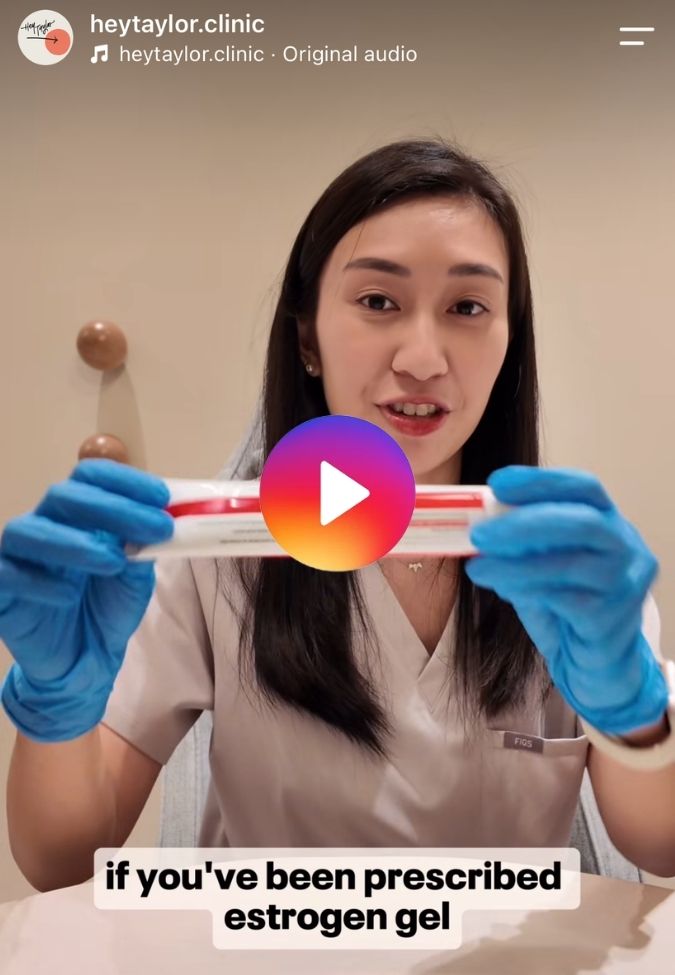 How to use your estrogen gel, with Dr Jody menopause doctor at Hey Taylor. Click to watch video!
If you still have a uterus and are using systemic oestrogen, you will generally need progesterone or another progestogen to protect the lining of the uterus.
One commonly used option is micronised progesterone, which has the same molecular structure as the progesterone naturally produced by the body.
It is often taken at bedtime because some women find it calming or sleep-promoting.
Other options include synthetic progestogens such as dydrogesterone and norethisterone.[3, 14]
If you prefer to take one tablet rather than separate oestrogen and progesterone, there are combined MHT tablets that contain both hormones.
These can be a convenient option for women who need both oestrogen and protection of the uterine lining.[3]
For women who are at least 12 months past their final period, another option is tibolone, a single daily tablet.
Tibolone is broken down by the body into compounds that have oestrogen-like, progesterone-like and mild androgen-like effects.
It can help relieve menopause symptoms such as hot flushes and may also benefit bone health, mood and sexual desire.
Your doctor will consider your age, menstrual status, symptoms and medical history before recommending tibolone.
You don’t necessarily need whole-body hormone treatment if your main symptoms are vaginal or urinary.
When oestrogen levels fall, the tissues around the vagina and urinary tract can become thinner, drier and more sensitive.
This can cause:
These symptoms are known as Genitourinary Syndrome of Menopause (GSM).[3, 4, 15]
Local vaginal oestrogen delivers a small amount of oestrogen directly to the vaginal tissues rather than throughout the whole body.
In Singapore, conjugated oestrogen cream is a commonly used vaginal oestrogen option.
Other options include:
At Hey Taylor, we offer estradiol and estriol vaginal creams as well as other local vaginal oestrogen options.
Only a small amount of local vaginal oestrogen is absorbed into the bloodstream, and it can be used long term in many women.[3]
It can also be used alongside systemic MHT if you have both whole-body menopause symptoms and vaginal or urinary symptoms.
MHT isn’t suitable for everyone, and some women prefer not to take hormones.
There are also non-hormonal prescription treatments for specific symptoms.
Fezolinetant is a non-hormonal treatment for moderate to severe hot flushes and night sweats.
It works on neurokinin 3 (NK3) receptors in the brain, which are involved in regulating body temperature.
Unlike MHT, it does not replace oestrogen or progesterone.
At Hey Taylor, MHT is available in several forms, including oestrogen gels, patches and tablets, progesterone, combined tablets, tibolone and local vaginal oestrogen. Most patients pay $60-$70 a month. A detailed pricing breakdown is below:
The most suitable option depends on your symptoms, medical history, whether you have a uterus, and your preferences. Your doctor will discuss the options with you before prescribing.
References

Perimenopause is treatable, and you don't need to wait for your periods to stop. What to look for, what the 2026 Singapore guidelines say, and what care costs.

Decreasing oestrogen during menopause can cause rapid changes in skin texture and hydration. We break down the science behind skin changes in menopause, why off-label vaginal creams may cause irritation, and explore options like estriol cream.
Struggles with midlife weight gain are deeply rooted in perimenopausal hormonal and metabolic shifts rather than a lack of discipline. Here is what can help.









.png)

