

Long before hot flushes or night sweats begin, many women notice changes in their skin. It may feel drier, fine lines may become more noticeable, and the skin may start to lose some of its firmness and elasticity.
One reason is falling oestrogen. Oestrogen helps maintain collagen, skin thickness, hydration and blood flow. As oestrogen levels fall during perimenopause and menopause, these changes can become more noticeable. In fact, more than 60% of postmenopausal women report noticeable changes in their skin.[1]
As oestrogen levels decline, you may notice:
Less collagen and firmness: Skin produces less collagen, which can make it thinner and less firm. Collagen can fall by up to 30% in the first five years after menopause.[1,2]
More dryness: Lower oestrogen can affect the skin barrier, making it harder for the skin to hold on to moisture. This can lead to dry, tight or flaky skin.[2,3]
Duller skin and slower healing: Changes in blood flow to the skin can affect how much oxygen and nutrients reach the skin, which may contribute to a duller appearance and slower healing.[3]
More uneven pigmentation: Hormonal changes can affect melanin, making dark spots and uneven skin tone more noticeable.[1]
Oestrogen, progesterone and DHEA all play a role in these changes. However, sun exposure remains one of the biggest external causes of skin ageing. Daily broad-spectrum sunscreen is therefore still important.[2,3]
Systemic MHT, including oestrogen tablets, patches, gels and sprays, can also benefit the skin. By replacing some of the oestrogen lost during menopause, it may help maintain skin thickness and elasticity.[1,4] Observational data consistently shows that postmenopausal women on systemic MHT experience significantly less dryness and fewer fine lines compared to those who are not.[1]
However, MHT is prescribed mainly to treat menopause symptoms and support overall health, rather than solely for cosmetic reasons.[2,3] For targeted facial renewal, topical interventions offer a direct, localised approach.
Important: HRT gels such as Oestrogel should not be applied to the face or directly onto wrinkles. They are designed to be absorbed through larger areas of skin, such as the arms or thighs. The alcohol in these gels can irritate delicate facial skin, cause dryness and damage the skin barrier. Applying them to the face may also lead to unpredictable hormone absorption.
Using vaginal oestrogen cream on the face has become popular online, including among some menopause doctors. Dr Mary Claire Haver has spoken about using vaginal oestrogen and topical estriol on her own face to help with menopause-related skin changes. [5,6]
There is some research suggesting that oestrogen can benefit ageing skin. A study in 1994 found that applying oestrogen cream to the face for 24 weeks improved skin thickness and reduced fine lines.[7]
However, this does not mean that vaginal oestrogen creams are suitable for facial use.
The ingredients may irritate facial skin: Some vaginal oestrogen creams contain ingredients such as sodium lauryl sulfate (SLS) and benzyl alcohol. These may be tolerated in vaginal formulations but can be irritating to delicate facial skin, especially if you have sensitive or rosacea-prone skin.[9]
We do not know exactly how the face absorbs these products: Vaginal oestrogen is designed for vaginal tissue. How it is absorbed when applied to the face, especially over a larger area, has not been well studied. This means the amount of oestrogen absorbed through the skin is uncertain.
If you want to target facial skin directly, topical estriol is another option that has been studied for menopausal skin changes.
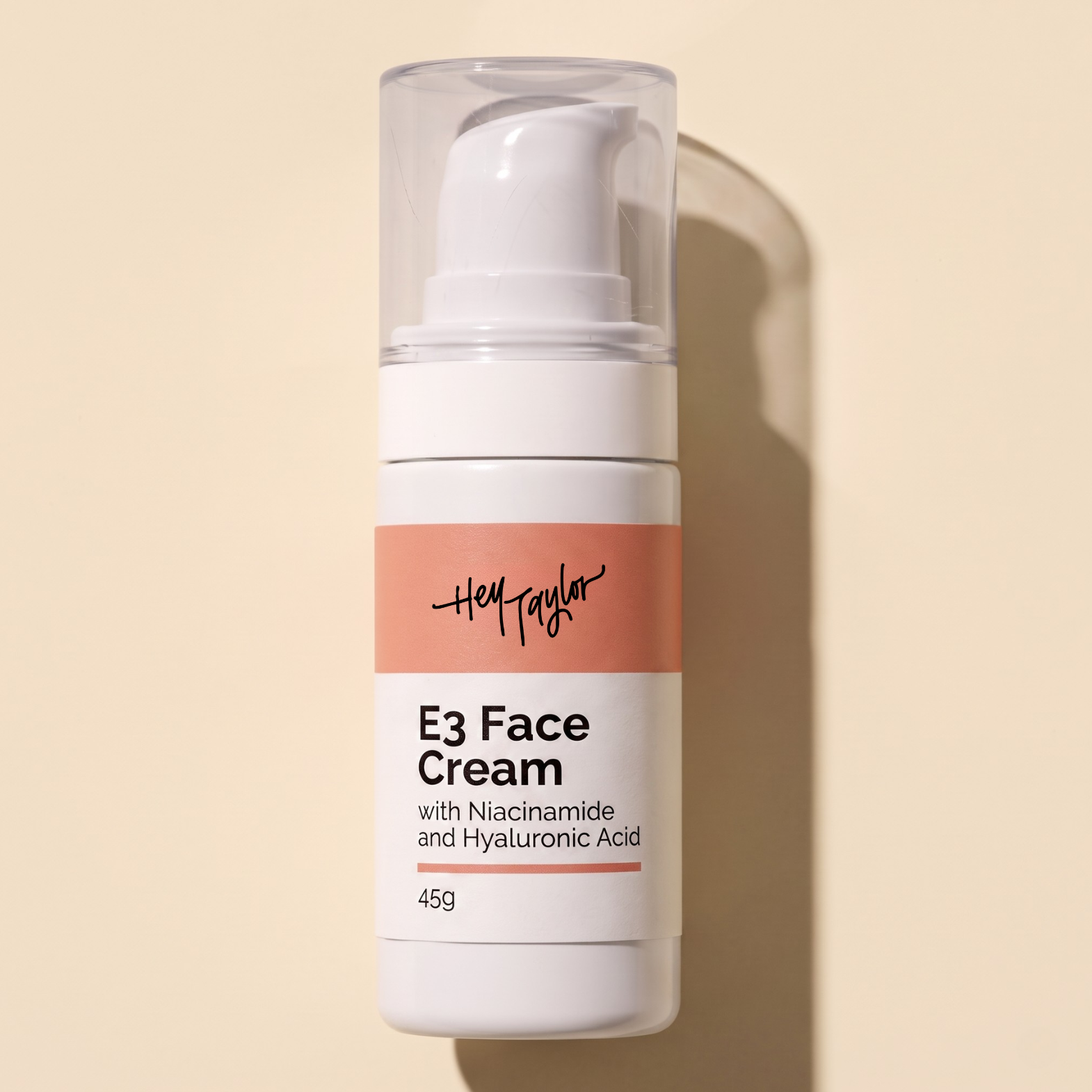
Estriol is a milder form of oestrogen than estradiol. When applied to the skin, it can act on oestrogen receptors and may help support collagen, skin thickness and elasticity.
One study compared estriol and estradiol creams used on the face for six months in perimenopausal women. Both improved signs of skin ageing, with slightly greater improvement seen with estriol.[8] Studies of the skin under a microscope have also found that topical estriol can increase skin thickness and improve the structure of elastic fibres.[4]
Blood tests also showed no significant changes in hormone levels, suggesting that the treatment mainly worked where it was applied.[8]
To improve overall formulation compatibility with facial skin and reduce potential irritation, low-dose estriol is often combined with complementary active ingredients that support the skin barrier:
Niacinamide (vitamin B3): Helps support the skin barrier and improve skin tone and texture.
Hyaluronic acid: Helps the skin retain moisture and can reduce dryness.
Facial-grade base: Designed specifically for delicate facial skin and avoids ingredients that may cause unnecessary irritation.
Menopause-related skin changes are real and are closely linked to falling oestrogen levels. While systemic MHT provides broad health benefits if you experience systemic symptoms, targeting facial skin directly is most effectively accomplished through facial-grade topical oestrogen formulations.
References

Perimenopause is treatable, and you don't need to wait for your periods to stop. What to look for, what the 2026 Singapore guidelines say, and what care costs.
Struggles with midlife weight gain are deeply rooted in perimenopausal hormonal and metabolic shifts rather than a lack of discipline. Here is what can help.
A guide to how menopause hormone therapy (MHT / HRT) works, the different options available in Singapore, what they cost, and whether MHT may be suitable for you.









.png)

