

If you are in your late 30s, 40s, or early 50s and noticing that your clothes fit differently, particularly around your waist, you are not alone. Many women find that the exact diets, calorie deficits, and exercise routines that worked effortlessly in their 20s and 30s suddenly produce zero results in midlife.
It is easy to blame a lack of discipline or willpower, but medical science reveals a very different story. Midlife weight gain and the accumulation of abdominal "belly fat" during perimenopause and menopause are driven by powerful biological, hormonal, and metabolic shifts [1, 2].
Understanding these changes is the first step toward finding solutions that work with your body’s evolving biology, rather than fighting against it.
During the menopausal transition, ovarian hormone production does not decline smoothly; it fluctuates unpredictably. These hormonal shifts trigger specific metabolic changes that promote weight gain and alter where your body stores fat [1, 2].
                 PERIMENOPAUSE HORMONAL SHIFT
                               │
       ┌───────────────────────┼───────────────────────┐
       ▼                       ▼                       ▼
Falling Oestrogen      Insulin Resistance       Sarcopenia (Muscle Loss)
       │                       │                       │
Visceral Fat Shift     Excess Fat Storage       Lower Metabolic Rate
(Abdominal Belly Fat)  & Carbohydrate Cravings  (Fewer Calories Burned)
Oestrogen plays a key role in directing fat storage toward the hips and thighs (gynoid fat). As oestrogen levels fall during perimenopause, fat storage preferentially shifts deep into the abdomen, surrounding internal organs as visceral adipose tissue (VAT) [1, 2].
Data from the landmark 18-year Study of Women's Health Across the Nation (SWAN) demonstrated that the rate of fat accumulation doubles and lean muscle mass declines beginning roughly two years before the final menstrual period and continuing for two years after—a pattern directly linked to ovarian hormone loss rather than chronological aging [1].
Declining oestrogen directly impairs insulin sensitivity in peripheral tissues and reduces pancreatic insulin secretion [2]. Coupled with subtle shifts in circulating androgen levels, this increased insulin resistance makes it harder for cells to clear glucose from the bloodstream, directing more energy into fat storage [2].
From age 35 onward, women experience a natural, progressive loss of muscle mass (sarcopenia), losing an estimated 1% to 1.5% of muscle per year post-menopause [2, 4]. Because muscle tissue is metabolically active and burns calories even at rest, losing muscle lowers your basal metabolic rate (BMR). When metabolic rate drops, eating the exact same number of calories results in gradual weight gain [2, 5].
When managing weight in midlife, relying solely on a bathroom scale or standard Body Mass Index (BMI) can be misleading [1, 6].
                        THE BATHROOM SCALE ILLUSION

           Traditional Scale                        DEXA Body Scan
        ┌──────────────────────┐               ┌──────────────────────┐
        │   Total Weight: 65kg │               │  Subcutaneous Fat    │
        │   (Shows No Change)  │               │  Visceral Fat (+2kg) │
        └──────────────────────┘               │  Lean Muscle (-2kg)  │
                                               └──────────────────────┘
During perimenopause, it is common to lose two kilograms of lean muscle while simultaneously gaining two kilograms of visceral fat [1]. In this scenario, your bathroom scale weight remains unchanged, masking a significant shift in your body composition and metabolic health [1, 6].
Dual-Energy X-ray Absorptiometry (DEXA) is considered the clinical gold standard for body composition analysis [1, 6]. Unlike standard scales, a DEXA scan precisely differentiates between:
Identifying elevated visceral fat is clinically important because visceral fat produces inflammatory adipokines that contribute to cardiovascular risk, dyslipidaemia, and metabolic dysfunction [1, 2, 7].
When addressing midlife weight gain, comprehensive medical evaluation helps rule out overlapping conditions and identify metabolic targets [8].
Effective midlife weight management requires a doctor-led, multi-pronged approach that addresses hormone stability, metabolic health, and muscle preservation [2, 8].
                     DOCTOR-LED MIDLIFE WEIGHT TOOLKIT
                                     │
       ┌─────────────────────────────┼─────────────────────────────┐
       ▼                             ▼                             ▼
Doctor-Led Interventions     Menopause Hormone Therapy     Preserving Muscle Mass
 (e.g. GLP-1 Medications)          (MHT / HRT)             (Protein & Resistance)
   Addresses Insulin          Restores Sleep & Joint         1.2–1.5 g/kg Protein +
  Resistance & Appetite       Comfort to Enable Movement     Strength Training
GLP-1 receptor agonists (such as semaglutide or tirzepatide) work by mimicking natural incretin hormones to improve insulin sensitivity, regulate blood sugar, delay gastric emptying, and reduce central appetite signaling [12, 13].
It is important to clarify that MHT is not prescribed as a direcy weight-loss treatment [8, 11]. International menopause and endocrine societies do not recommend MHT solely for reducing weight [8, 11].
However, clinical trials demonstrate that women using MHT experience less belly fat accumulation and smaller increases in waist circumference compared to non-users [1, 6, 9].
By treating bothersome symptoms like poor sleep, joint aches, and mood shifts, MHT also helps restore the energy and physical comfort required to maintain active, healthy lifestyle habits [2, 8].
To protect metabolic rate and muscle mass during midlife weight loss:
At Hey Taylor, our doctors take an evidence-based medical approach to weight management. We assess the factors that may be contributing to your weight changes, then use the findings to develop a plan tailored to you.
What’s included:
Meet with a doctor to discuss your symptoms, medical history, medications, lifestyle and weight management goals. Your doctor will also assess whether menopause symptoms or MHT may be relevant to your care.
Blood tests assess blood sugar, insulin resistance, cholesterol and triglycerides. They also look at liver and thyroid function, with selected vitamins and minerals assessed where clinically appropriate.
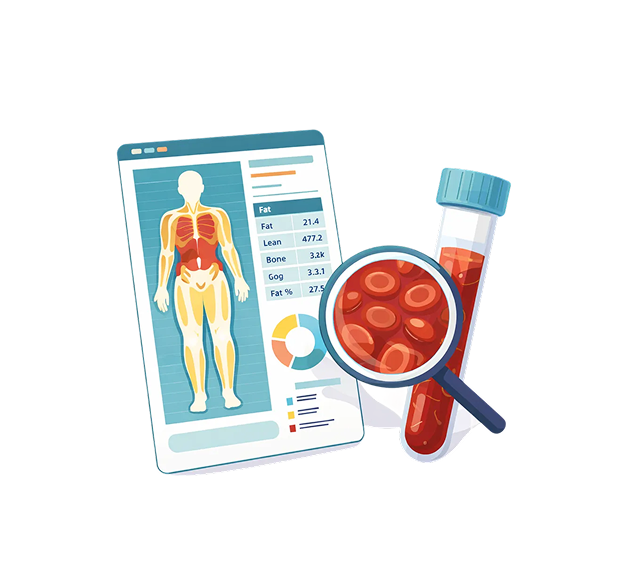
A DEXA scan measures your muscle mass, visceral fat and bone mass, providing a detailed picture of your body composition. This is particularly useful during midlife and menopause, when changes in muscle and fat distribution can affect weight and metabolic health. It also gives your doctor a reliable baseline for developing and tracking your weight-management strategy.
Your doctor will review your results with you and discuss the most appropriate next steps. This may include nutrition and exercise guidance, lifestyle changes or menopause management. Prescription weight-management treatments such as GLP-1 medications may also be considered when clinically appropriate.
Yes. Falling oestrogen levels alter fat distribution, shifting storage from subcutaneous areas (hips and thighs) to visceral adipose tissue inside the abdomen [1, 2]. You may notice your waistline expanding even if your total weight on the scale stays constant [1, 6].
Yes, GLP-1 receptor agonists can be prescribed during perimenopause and menopause under medical supervision [12, 16]. Your doctor will evaluate your health profile and recommend structured resistance training and protein guidelines to protect muscle mass during treatment [16, 19].
No. Clinical evidence shows that MHT does not cause weight gain [1, 6]. In fact, studies show that women taking MHT experience less abdominal visceral fat accumulation across the menopause transition compared to non-users [1, 6, 9]. While temporary fluid retention or bloating can occur during the first few weeks of starting MHT, this resolves on its own and does not represent fat gain.
References
El Khoudary SR, Aggarwal B, Beckie TM, et al. Menopause Transition and Cardiovascular Disease Risk: Implications for Timing of Early Prevention: A Scientific Statement From the American Heart Association. Circulation. 2020;142(25):e506-e532. doi:10.1161/CIR.0000000000000912.
Nappi RE, Chedraui P, Lambrinoudaki I, Simoncini T. Menopause: A Cardiometabolic Transition. The Lancet Diabetes & Endocrinology. 2022;10(6):442-456. doi:10.1016/S2213-8587(22)00076-6.
Vieira-Potter VJ, Mishra G, Townsend KL. Health of Adipose Tissue: Oestrogen Matters. Nature Reviews Endocrinology. 2025;21(3):145-158. doi:10.1038/s41574-025-01180-2.
Zhang W, Wu Q, Chen Q, et al. Adipose-Muscle Crosstalk During the Menopausal Transition: Mechanistic Links to Sarcopenic Obesity in Midlife Women. Frontiers in Endocrinology. 2026;17:1805067. doi:10.3389/fendo.2026.1805067.
Farhana F, Sultana MA, Hia RA, Hegde V. Postmenopausal Sarcopenia and Alzheimer's Disease: The Interplay of Mitochondria, Insulin Resistance, and Myokines. Neuroscience and Biobehavioral Reviews. 2025;170:106501. doi:10.1016/j.neubiorev.2025.106501.
Papadakis GE, Hans D, Gonzalez Rodriguez E, et al. Menopausal Hormone Therapy Is Associated With Reduced Total and Visceral Adiposity: The OsteoLaus Cohort. The Journal of Clinical Endocrinology and Metabolism. 2018;103(5):1948-1957. doi:10.1210/jc.2017-02449.
Dong J, Hillman S, Dixon S, et al. Hormone Replacement Therapy for Menopausal Symptoms and the Risk of Cardiometabolic Disease: Current Evidence and Future Directions. BJOG: An International Journal of Obstetrics and Gynaecology. 2026;133(2):180-192. doi:10.1111/1471-0528.70214.
Kapoor E, Collazo-Clavell ML, Faubion SS. Weight Gain in Women at Midlife: A Concise Review of the Pathophysiology and Strategies for Management. Mayo Clinic Proceedings. 2017;92(10):1552-1558. doi:10.1016/j.mayocp.2017.08.004.
Hetemäki N, Robciuc A, Vihma V, et al. Adipose Tissue Sex Steroids in Postmenopausal Women With and Without Menopausal Hormone Therapy. The Journal of Clinical Endocrinology and Metabolism. 2025;110(2):511-522. doi:10.1210/clinem/dgae458.
Van Pelt RE, Gozansky WS, Wolfe P, et al. Estrogen or Raloxifene During Postmenopausal Weight Loss: Adiposity and Cardiometabolic Outcomes. Obesity (Silver Spring). 2014;22(4):1024-1031. doi:10.1002/oby.20653.
Kunicki M, Katulska Z, Wolert W, Kunicka A. Obesity Treatment for Postmenopausal Women: Established Therapies and Emerging Approaches - A Narrative Review. Maturitas. 2026;211:109025. doi:10.1016/j.maturitas.2026.109025.
Moiz A, Filion KB, Toutounchi H, et al. Efficacy and Safety of Glucagon-Like Peptide-1 Receptor Agonists for Weight Loss Among Adults Without Diabetes: A Systematic Review of Randomized Controlled Trials. Annals of Internal Medicine. 2025;178(2):199-217. doi:10.7326/ANNALS-24-01590.
Vienghirun J, Sawangjit R, Suttiruksa S, et al. GLP-1 Receptor/Dual Agonists for Weight Loss: A Systematic Review and Network Meta-Analysis of RCTs. Diabetes, Obesity & Metabolism. 2026;28(6):5043-5057. doi:10.1111/dom.70698.
Ruder K. At ObesityWeek, More Data and Questions About Semaglutide, Tirzepatide, and Retatrutide. JAMA. 2024;331(1):9-11. doi:10.1001/jama.2023.23123.
Alexander GC, Xiao X, Dilek S, et al. Heterogeneity of Treatment Effects of Glucagon-Like Peptide-1 Receptor Agonists for Weight Loss in Adults. JAMA Internal Medicine. 2026;186(3):284-295. doi:10.1001/jamainternmed.2025.8222.
Mozaffarian D, Agarwal M, Aggarwal M, et al. Nutritional Priorities to Support GLP-1 Therapy for Obesity: A Joint Advisory From the American College of Lifestyle Medicine, the American Society for Nutrition, the Obesity Medicine Association, and the Obesity Society. The American Journal of Clinical Nutrition. 2025;122(1):344-367. doi:10.1016/j.ajcnut.2025.04.023.
Lieberman DE, Aslan DH, Heymsfield SB. The Conundrum of Exercise for Weight Management in the GLP-1 Receptor Agonist Era. JAMA. 2026;335(4):312-320. doi:10.1001/jama.2026.5537.
Sawicka-Gutaj N, Gruszczyński D, Nijakowski K, et al. GLP-1 Agonists and Changes in Body Mass and Composition in Adults With Overweight or Obesity With or Without Type 2 Diabetes Mellitus: A Systematic Review and Meta-Analysis. International Journal of Obesity. 2026;50(2):410-422. doi:10.1038/s41366-026-02088-1.
Locatelli JC, Costa JG, Haynes A, et al. Incretin-Based Weight Loss Pharmacotherapy: Can Resistance Exercise Optimize Changes in Body Composition? Diabetes Care. 2024;47(10):1718-1730. doi:10.2337/dci23-0100.
Neeland IJ, Linge J, Birkenfeld AL. Changes in Lean Body Mass With Glucagon-Like Peptide-1-Based Therapies and Mitigation Strategies. Diabetes, Obesity & Metabolism. 2024;26(Suppl 4):16-27. doi:10.1111/dom.15728.
Ioannidou P, Dóró Z, Schalla J, et al. Analysis of Combinatory Effects of Free Weight Resistance Training and a High-Protein Diet on Body Composition and Strength Capacity in Postmenopausal Women: A 12-Week Randomized Controlled Trial. The Journal of Nutrition, Health & Aging. 2024;28(10):100349. doi:10.1016/j.jnha.2024.100349.
Larsen MS, Witard OC, Holm L, et al. Dose-Response of Myofibrillar Protein Synthesis to Ingested Whey Protein During Energy Restriction in Overweight Postmenopausal Women: A Randomized, Controlled Trial. The Journal of Nutrition. 2023;153(11):3173-3184. doi:10.1016/j.tjnut.2023.08.011.
Li J, Jiang L, Saquib N, et al. Estimating the Effect of Hypothetical Dietary Protein Interventions on Changes in Body Composition of Postmenopausal Women Over 3 Years Using Data From the Women's Health Initiative (WHI) Study: An Emulated Target Trial. International Journal of Obesity. 2026;50(3):609-617. doi:10.1038/s41366-025-01978-0.


Over 70% of women in Singapore experience menopause m shifts, yet most go untreated. Here is your complete guide to KKH guidelines, MHT choices, MediSave, and getting care that actually connects the dots.

Decreasing oestrogen during menopause can cause rapid changes in skin texture and hydration. We break down the science behind oestrogen depletion, why off-label vaginal creams may cause irritation, and explore options like estriol cream.
A guide to how menopause hormone therapy (MHT / HRT) works, the different options available in Singapore, what they cost, and whether MHT may be suitable for you.



%20(680%20x%20250%20px)%20(1).svg)

